-
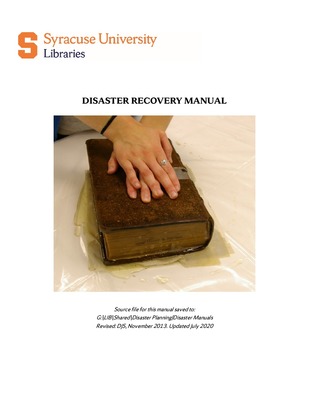
Disaster Recovery Manual (2020)
David Stokoe, Marianne Swanberry Hanley, Thomas House, and Syracuse University Libraries
The Syracuse University Libraries’ Disaster Recovery Plan for library materials outlines procedures for salvaging a wide variety of library materials in the event of a disaster of minor emergency. We have designed this plan to help library staff cope with and recover materials from minor emergencies that typically involve 500 or less items. The majority of these emergencies will be caused by interior flooding due to leaky pipes (or water coming in from other vulnerable areas in library buildings) or from patron mishaps. The resultant wet books and other objects, such as photographs, microfilm, and sound recordings, can usually be dried on location and returned to service with minimal effort. Please note that this document takes effect after the safety and security of library staff and patrons has been secured.
-
Universal Service: Competition, Interconnection and Monopoly in the Making of the American Telephone System
Milton Mueller
This book, based on years of archival research at the AT&T/Bell Labs in the aftermath of the divestiture, was originally published in 1997 as part of the MIT Press/AEI Series on Telecommunications Regulation. Acclaimed by reviewers such as Lawrence Lessig as “extraordinary” and “a crisply written mix of history and clear theory,” the small press run was sold out by 2002. Nevertheless, every year I encountered people who asked where they could get copies. The AEI series had long come to an end, its funds gone and its editorial team disbanded, making a new press run all but impossible.
It was when I saw Amazon offering used hardcover copies of the book for $249.00 that I decided something had to be done. I seized the opportunity presented by the negotiation of a contract for my then-new book Networks and States: The Global Politics of Internet Governance to reclaim the copyright for Universal Service. I decided to make it available as an open ebook through the Syracuse University SUrface. But since I possessed neither the original galleys nor my manuscript in computerized form, the ebook had to be created almost from scratch, by scanning a printed manuscript, converting the resulting pdf file into a Word document, and then engaging in a lot of manual labor to improve the format and fixing all the conversion errors and typos. It took some time to do this. I would like to thank Natasha Cooper, Yuan Li of the Syracuse University Library and Chubing Hong, a Master’s student at the iSchool, for their dedicated help in making that happen!
Here, with only a few copy editing revisions, is the ‘shiny’ new digital version of Universal Service: Competition, Interconnection and Monopoly in the Making of the American Telephone System.
All rights reserved by Milton L. Mueller 2013.
-

Sozialpolitik nach dem Verursacherprinzip : Beispiele der Anwendung bei Sucht, Gewichtsproblemen, Medikamentenmissbrauch, Arbeitslosigkeit, Prostitution
Isidor Wallimann
Dieses einzigartige Buch ist der "Praxisband" des bekannten und renommierten Experten im Bereich der modernen Sozialpolitik. In mehr und mehr Ländern wird punktuell das Verursacherprinzip auch in der Sozial- und Gesundheitspolitik angewendet, leider zu bruchstückhaft und oft wenig reflektiert. Sozialpolitik nach dem Verursacherprinzip ist genau jenes Thema, dass kontroversiell diskutiert wird. Prominente Fallbeispiele wie zB im Bereich der Tabakindustrie in den USA prägen die Diskussion und gesellschaftspolitischen Diskurse.
Im Idealfall sollen mit dem Verursacherprinzip Soziale Probleme und Belastungen an alle dafür verantwortlichen Akteure zurückgebunden und so vermieden werden. Akteure, die andern Schaden zufügen, müssen dafür die Verantwortung übernehmen. Kosten zu „sozialisieren“ während Nutzen und Gewinne „privatisiert“ werden, soll unterbunden werden.
Das Verursacherprinzip kann mit verschiedenen Methoden angewendet werden. Sie sind politisch mehr oder weniger gut akzeptiert und haben unterschiedliche Wirksamkeit. Hier ist die Debatte voll im Gang. Viel davon ist uns schon seit 40 Jahren aus der Umweltpolitik bekannt.
Dieses Buch zeigt an aktuellen Beispielen einige Möglichkeiten (und Schwierigkeiten) auf, das Verursacherprinzip in der Sozialpolitik systematisch anzuwenden. -
Disaster Recovery Manual (2010)
David J. Stokoe and Department of Preservation and Conservation
The Syracuse University Library Disaster Recovery Plan for library materials outlines procedures for salvaging a wide variety of library materials in the event of a disaster of minor emergency. We have designed this plan to help library staff cope with and recover materials from minor emergencies that typically involve 500 or less items. The majority of these emergencies will be caused by interior flooding due to leaky pipes (or water coming in from other vulnerable areas in library buildings) or from patron mishaps. The resultant wet books and other objects, such as photographs, microfilm, and sound recordings, can usually be dried on location and returned to service with minimal effort. Please note that this document takes effect after the safety and security of library staff and patrons has been secured.
For more information see http://library.syr.edu/about/departments/preservation/recovery and http://researchguides.library.syr.edu/content.php?pid=34915&sid=275074.
-

Will the Real America Please Stand Up
Renate "Rennie" Simson
This small volume is an attempt to analyze the reality of the "Two Americas". The gap between the two (the 'haves' and 'have nots') has been steadily widening and this book offers a clear and simple presentation of the facts and figures that depict this 'gap'.
-

Sozialpolitik nach Verursacherprinzip : Beispiele der Anwendung aus Arbeit, Gesundheit, Sucht, Schule und Wohnen
Isidor Wallimann
Sozialpolitik nach Verursacherprinzip explores the application of the polluter pays principle to a variety of social policies. It specifically examines possibilities in labor, health, addiction, education, and housing policies.
-

Bullish on Life
Gerald B. Cramer
This is an autobiography by Gerald B. Cramer.
Gerald B. Cramer `52 is co-founder and chairman emeritus of Cramer Rosenthal & McGlynn LLC, an investment firm that manages over $10 billion. Cramer has had overall responsibility for its investment policy and was also a portfolio manager. He received his B.S. in accounting from the Martin J. Whiman School of Management at Syracuse University and attended the University of Pennsylvania`s Wharton School of Business. He served as a lieutenant in the U.S. Navy during the Korean War.
Cramer has sat on the boards of Ripplewood Holdings; Tecnomatix Technologies Ltd., where he was chair; OSHAP Technologies; Prime Ventures; Glenayre Technologies; Edison Control Corp; and ProxyMed Inc. His community service activities include serving as director of Teatown Lake Reservation and formerly serving on the boards of St. Joseph`s Medical Center and the Glaucoma Foundation.
Cramer has served on Syracuse University`s Board of Trustees since 1995, including a term as vice chairman. He has been a strong supporter of Lubin House and the High School for Leadership and Public Service. He has served as a member of the SU School of Architecture Advisory Board and the Metropolitan New York Advisory Board. In 2003, he was a lecturer for the Berman Distinguished Lecture Series at the Whitman School.
He has also been a major benefactor of the Maxwell School at Syracuse University. More than three dozen students have been recipients of Cramer Scholarships; currently, four members of the Maxwell faculty hold the title of Cramer Professor.
In June 2004, Cramer was selected as the first recipient of the Maxwell School Horizon Award, which was established to recognize wise, inspirational volunteer leadership combined with exceptional philanthropic commitment. In 2006, Cramer was awarded the George Arents Pioneer Medal, the highest alumni honor Syracuse University bestows.
-
urban logic(s)
Syracuse University School of Architecture
This book includes a wide range of essays and ideas concerning today's urban issues, and specifically that of Syracuse.
-

Bruce Abbey Drawings and paintings 1965- 2000
Bruce J. Abbey
Bruce Abbey Drawings and paintings 1965- 2000
-
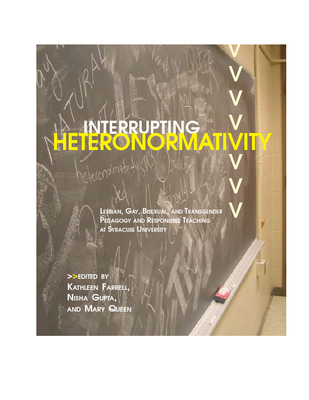
Interrupting Heteronormativity: Lesbian, Gay, Bisexual, and Transgender Pedagogy and Responsible Teaching at Syracuse University
Kathleen Farrell, Nisha Gupta, and Mary Queen
-

Sozialpolitik Anders Denken. Das Verursacherprinzip – von der Umweltpolitischen zur Sozialpolitischen Anwendung
Isidor Wallimann and Esteban Piñeiro
The “polluter pays” principle in environmental law assumes that the actor would reduce or avoid adverse effects of his actions if he had to bear the consequences of those actions (internalization of effects). Such internalization can generally be done in two ways: either by avoiding or eliminating the harmful effects or by wearing the financial consequences of the injury. It is therefore on the one hand to have an incentive effect, on the other to a compensatory effect.
Pineiro and Wallimann apply these societal cost principles from the environmental world to the social realm, where social problems can be seen as negative externalities caused by anything or anyone - which raises the question of the causes or perpetrators. It is indisputable that social problems, in fact, usually occur as a result of human activity, but to clearly identify the root cause can be infinitely more difficult than in the environmental field, where the evidence can be done using scientific inquiry. In advocating their case, Pineiro and Wallimann develop guidelines for a possible application of the polluter pays principle to the social sector, and additionally, highlight selected societal problem areas in the area of alcohol, unemployment, and disabilities where this could be applied.
-

Das Zeitalter der Knappheit – Ressourcen, Konflikte, Lebenschancen
Isidor Wallimann and Michael Dobkowski
Michael N. Dobkowski and Isidor Wallimann establish a disturbing but realistic scenario of the disastrous future that awaits humankind as surplus populations collide with dwindling resources. Authors consider a number of cause-and-effect situations on industrialization, biophysical limits, exponential population growth, and genocide, to name a few. This volume is a critical contribution to the field and will serve as an ideal introduction to courses in the environment, population, resources, genocide, and social conflict.
-
Using Writing to Teach
Payal Banerjee, Kara Bopp, John Draeger, Hilton Hallock, and Tobi Jacobi
This text represents a year of research, dialogue, collaboration, and difference between teachers and scholars from at least nine disciplines at Syracuse University. The conversations and resources gathered here are intended to function as a practical and pedagogical tool for using writing in the university classroom. It is written in such a way that readers can use it as a linear text or as a sourcebook for specific questions, concerns, and teaching needs.
-

Weg von der Armut durch soziokulturelle Integration : Bei Sozialhilfeabhängigkeit, Alter und Behinderung
Jonas Strom, Matthias Szadrowsky, and Isidor Wallimann
A person who has to live alone is marginalized and impoverished socially and culturally. A person must be able to participate in society - through education, culture, through the inclusion in civil society organizations, family and politics. If this is achieved, it will result in the person having more opportunities to secure this social and material existence and will more slowly become financially dependent and would be dependent for a shorter period of time. This in turn means financial relief for the State. It also ensures that human rights are afforded and promotes personal development.Previous research has provided many answers about controlling material poverty. The theme of this study is how to better understand, recognize and address socio-cultural poverty.
-

Soziale Arbeit und Ökonomie : Politische Ökonomie - Arbeitsmärkte - Sozialpolitik Grenzen der Ökonomisierung - Soziale Ökonomie Gemeinwesenentwicklung - Bürgergesellschaft
Susanne Elsen, Dietrich Lange, and Isidor Wallimann
Globalization has seen the removal of borders and increased global flows of capital and goods and services, changing the employment landscape, pressuring revenues and social-welfare spending of modern welfare states. This collection of essays brings together perspectives from different disciplines to discuss the role globalization has had on social policies of the modern welfare state and the changing relationship between social policy, social work and the economy, describes its consequences and presents innovative approaches for action.
-
The Coming Age of Scarcity : Preventing Mass Death and Genocide in the Twenty-first Century
Michael N. Dobkowski and Isidor Wallimann
The structure of the book is simple. The first part analyzes major forces having an impact on the survivability of civilization as we know it into the twenty-first century. It outlines the challenges we face, including overpopulation, pressure upon the land, migration, ecological damage, and social instability. In part two, we present more detailed discussion of the problem of scarcity and how it relates to conflict. The authors in this section argue that the current level of human activity is unsustainable. They demonstrate that population growth in particular affects the natural world and can affect the social order and international political systems.The authors in part three go beyond the empirical and theoretical studies of the first two parts to examine how scarcity has already led to mass death and genocide in Rwanda, Bosnia, Somalia, and Haiti and to speculate on the likelihood that scarcities could be a more decisive factor in genocide in the future.
-

Armut : der Mensch Lebt Nicht vom Brot Allein : Wege zur Soziokulturellen Existenzsicherung
Isidor Wallimann and Susanne Schmid
While the usual discussion about the poverty of the minimum financial security speaks, the authors ask what it could mean for to be living in a secure socio-cultural minimum. The fact is that poverty can be both "caused" by various forms of exclusion, as well as the socio-cultural exclusion promotes or "causes".
-

Entmündigung und Emanzipation durch die Soziale Arbeit : Individuelle und strukturelle Aspekte
Stefan Eugster, Esteban Pineiro, and Isidor Wallimann
Entmündigung und Emanzipation durch die Soziale Arbeit explores the effects of different aspects of the social work profession. It specifically examines how social work can emancipate or incapacitate people.
-

Tales of Mendele the Book Peddler
Ken Frieden and Dan Miron
Born in Belorussia in 1836, S. Y. Abramovitsh was the founding father of modern Yiddish fiction. His stories and novels depict small-town Jewish life i nthe Russian Pale of Settlement through the hilarious, satiric, and sympathetic tales of his alter ego/narrator, Mendele the Book Peddler ("Mendele Moykher Sforim"). This itinerant peddler, who travels the Pale collecting good stories, was so closely identified with Abramovitsh's fiction that "Mendele" became the author's pen name.
This volume---the fourth in Schocken's acclaimed Library of Yiddish Classics---brings together two of Abramovitsh's best-loved novellas:"Fishke the Lame," a bittersweet love story set in the world of beggars, paupers, and rogues, and "The Brief Travels of Benjamin the Third," the comical misadventures of a Quixote-Panza pair who set off to see the world outside their town. These tales, in superb new translations by Ted Gorelick and Hillel Halkin, represent Yiddish storytelling at its best---full of heart, humor, and homespun wisdom.
-

Selbstverwaltung: Entwicklungen und Perspektiven, Soziale Bewegungen, Krisen und Soziale Ökonomie
Mathias Hasler, Franziska Amstutz, Simone Seiler, Olivier Mounir, Bernard Gailloz, and Isidor Wallimann
Self-Managed Firms in Switzerland: Developments and Perspectives, social Movements, Crisis and the Social Economy
-
Genocide In Our Time : An Annotated Bibliography With Analytical Introductions
Michael N. Dobkowski, Isidor Wallimann, Alison Palmer, Alan Rosenberg, Evelyn Silverman, Sidney M. Bolkosky, Agi Rubin, Rouben Adalian, Lyman H. Legters, Eric Markusen, and Israel W. Charny
Genocide is a modern term whereby groups of people are killed on the basis of their religion, race, ethnicity, or nationality. This book suggest that modernity and the tremendous social differentiation that is a part of our modern world may, in part, be to blame. The authors examine textbook 20th century horrors: from the massacre of the Armenians, to the planned famine in the Ukraine, to the Holocaust, and links of modern warfare to genocide. By studying cases of genocide, the authors hope to inform and connect to all other efforts to understand and to prevent the mass destruction of human lives.
The work of Markusen, Legters, and Palmer focuses on phenomena that are not classically defined as genocide but, since they show many points of intersection, are highly important to the study of genocide. Thus Palmer explores numerous policies towards ethnic minorities worldwide and shows their overt and covert ethnocidal dimensions, while, in the Ukrainian case chosen by Legters, the issue is one of demarcation. Should the Ukrainian famine be viewed as a case involving an economic catastrophe, as a political conflict, as ethnocide, as mass killing, or as genocide? How were these dimensions connected or could they have been? Linkages are also the theme of Markusen's investigation, which looks at the possible connections between modern war and genocide, particularly as it concerns the nature of modern war and its social, psychological, and organizational foundations in modernity. Aspects of the latter are also used by Dobkowski and by Rosenberg and Silverman in their analyses of the Holocaust. Dobkowski views the Holocaust as the paradigmatic genocide. It introduced an unprecedented technological mass killing. It represents a kind of ultimate confrontation with death, faceless and unmediated. Rosenberg and Silverman further demonstrate the criteria under which the Holocaust can be viewed as a unique event. Adalian describes in detail the methods by which the Turkish genocide against the Armenians has been covered up, excused, and denied. Simultaneously, we obtain a good account of the event itself, including some of its causes and consequences. Finally, the manner and dynamic in which the Armenian genocide has been articulated, relativized, and denied can serve in the development of intervention strategies and early warning systems such as those that Charny proposes in his essay.
-

Freud's Dream of Interpretation
Ken Frieden
Frieden explores methods of dream interpretation in the Bible, the Talmud, and in the writings of Sugmund Freud, and brings to light Freud's Troubled relationship to his Judaic forerunners. This book reveals unfamiliar associations in intellectual history and challenges received ideas in biblical, Talmudic, and Freudian scholarship.
-
Radical Perspectives on the Rise of Fascism in Germany, 1919-1945
Michael N. Dobkowski and Isidor Wallimann
The rise of National Socialism in Germany and the resulting Holocaust has proven to be one of the most engaging subjects of historical reflection. Rather than presenting the Weimar Republic as a failed democracy, flawed in both its political culture and its democratic institutional tradition, and undermined by an economic collapse, the emphasis here will be on seeing it as a developed capitalist society with distinct structural deficiencies and contradictions that weakened it from the outset.
-

Genocide and the Modern Age: Etiology and Case Studies of Mass Death
Isidor Wallimann, Michael Dobkowski, and Richard L. Rubenstein
-

Genius and Monologue
Ken Frieden
"Genius is the intellectual obsession of our time," Ken Frieden writes, "and monologue is one symptom of the disorder." From ancient, spiritual conceptions of genius to modern notions of the extraordinary mind, Frieden traces associated philosophic and literary expressions of inspiration and individuality.
Frieden juxtaposes the evolving forms of genius with traditions of monologue in pre-Shakespearean and Shakespearean drama, Romantic poetry, and nineteenthand twentieth-century fiction. He delineates the linguistic mechanisms that have shaped the dominant ideology of genius, showing that while literary monologues typically break the conventions of dialogue, aethetics ultimately identifies originality with deviance and madness. The successive guises of genius have gradually displaced divine intervention, and language has usurped the role of external inspiration.
Ken Frieden's provocative and wideranging study revises some traditional assumptions of literary theory and intellectual history and sheds light on the fictions of divinity and subjectivity in literature. It will interest scholars and students of literary theory as well as comparativists, intellectual and literary historians, and philosophers.
Printing is not supported at the primary Gallery Thumbnail page. Please first navigate to a specific Image before printing.